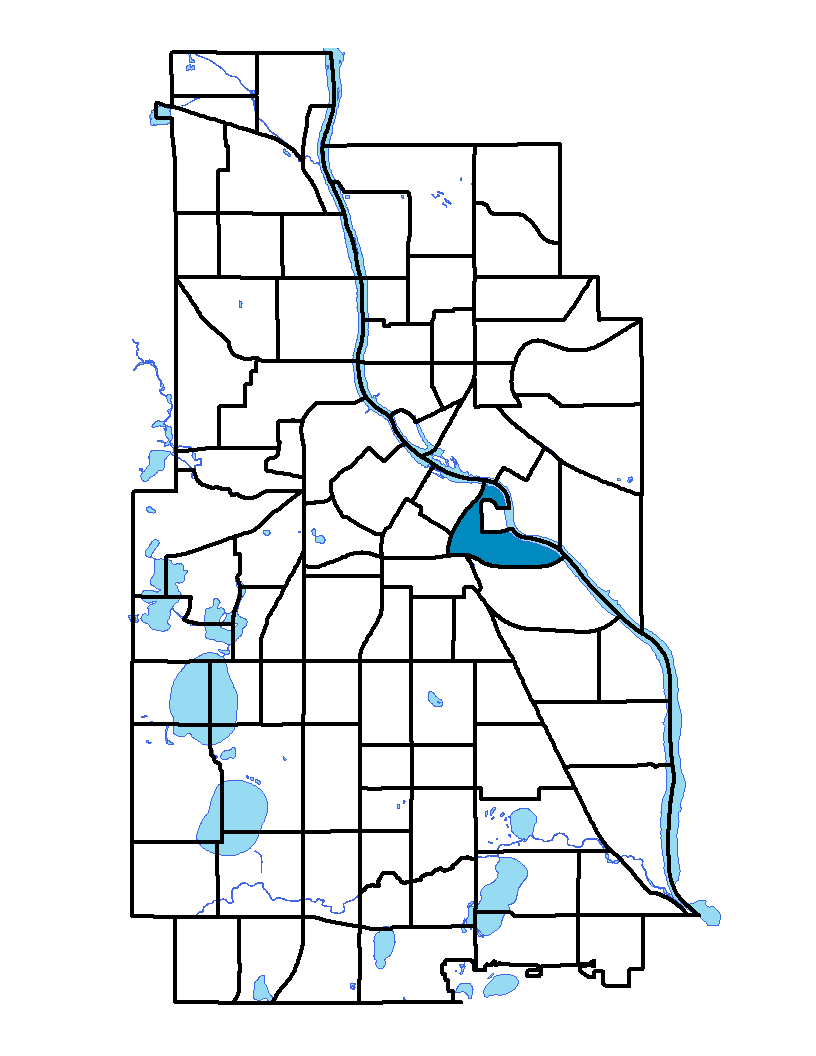
The Cedar-Riverside neighborhood is named after the intersection of the two main avenues of the neighborhood, Cedar and Riverside. The neighborhood is triangular-shaped with three definitive boundaries: the Mississippi River on the east side, Interstate 94 on the south side, and Interstate 35W on the west side. Cedar-Riverside‘s history is nearly as old as Minneapolis'. In the late 1890s, the neighborhood was known as "Snoose Boulevard," with a thriving community of Scandinavian immigrants, many of whom worked in the milling and lumber industries on the Mississippi River. In the 1960s and 1970s, Snoose Boulevard turned from a quaint neighborhood to a beehive of hippies, intellectuals, actors, artists and musicians. Presently, the Cedar-Riverside neighborhood boasts the largest community of immigrants in the Twin Cities, continuing a long history of ethnic and cultural diversity.
To learn more about the neighborhood association visit: www.westbankcc.org
Indicator Details
| Indicators | Primary Domain | Indicator Value |
Rank |
Tier |
|---|---|---|---|---|
| Reading Proficiency | Educational Opportunities | -% | - | Data N/A |
| Chronic School Absence | Health Systems and Public Safety | -% | - | Data N/A |
| High School Graduation Rate | Educational Opportunities | -% | - | Data N/A |
| School Readiness Scores | Educational Opportunities | -% | - | Data N/A |
| Commute Mode Share | Transportation | 56.1% | 3 | Top |
| Access to Parks and Open Space | Natural Areas | 24.7% | 4 | Top |
| Pedestrian Connectivity | Transportation | 309.6 | 4 | Top |
| Age of Housing | Housing | 58.2% | 6 | Top |
| Household Transportation Costs | Transportation | 13.0% | 6 | Top |
| Travel Time to Work | Employment Opportunities | 19.5 minutes | 7 | Top |
| Tree Cover | Natural Areas | 35.2% | 9 | Top |
| Walkability | Neighborhood Characteristics | 83 | 11 | Top |
| Transit Accessibility | Transportation | 534.4 | 11 | Top |
| Blood Lead Levels in Children | Housing | 1.9% | 18 | Top |
| Preschool Enrollment | Educational Opportunities | 62.1% | 25 | Top |
| Food Desert | Neighborhood Characteristics | 66.7% | 27 | Top |
| Low Birth Weight | Health Systems and Public Safety | 6.1% | 31 | Middle |
| Violent Crime | Health Systems and Public Safety | 42 | 36 | Middle |
| Voter Participation | Social Cohesion | 25.3% | 46 | Middle |
| Offsite Alcohol Outlets | Neighborhood Characteristics | 1.7 | 55 | Middle |
| School Proximity to Traffic | Environmental Hazards | 100.0% | 57 | Middle |
| Proximity to Brownfield Sites | Environmental Hazards | 13.8% | 62 | Bottom |
| Proximity to Superfund Sites | Environmental Hazards | 50.0% | 63 | Bottom |
| Vacancy Rates | Housing | 11.2% | 64 | Bottom |
| Toxic Releases from Facilities | Environmental Hazards | 67.2% | 70 | Bottom |
| Motor Vehicle Collisions | Health Systems and Public Safety | 32.1 | 75 | Bottom |
| Employment Rate | Employment Opportunities | 51.5% | 77 | Bottom |
| Local Business Vitality | Economic Health | 43.6% | 78 | Bottom |
| Public Assisted Households | Employment Opportunities | 69.4% | 79 | Bottom |
| Access to Mainstream Financial Services | Economic Health | 48.9% | 79 | Bottom |
| Long-Term Unemployment | Employment Opportunities | 9.9% | 79 | Bottom |
| Adult Educational Attainment | Educational Opportunities | 67.0% | 80 | Bottom |
| Business Retention | Economic Health | -4.7% | 82 | Bottom |
| Residential Proximity to Traffic | Environmental Hazards | 62.1% | 84 | Bottom |
| Residential Mobility | Social Cohesion | 48.9% | 84 | Bottom |
| Excessive Housing Cost Burden | Housing | 52.3% | 84 | Bottom |
| Preventable Hospitalizations | Health Systems and Public Safety | 59.9 | 86 | Bottom |